


15+ game-changing questions for an employee benefits broker RFP that delivers

A great benefits broker RFP is made up of insightful questions that strategically uncover benefits brokers’ values, services, and level of support. Here’s our HR expert-approved list of the top must-have questions to include in your RFP.
Choosing the right employee benefits broker is one of the most important decisions HR and finance leaders make. The right partner helps you control healthcare costs, reduce administrative burden, and improve the employee experience. The wrong one leaves you with the same spreadsheets, the same headaches, and the same year-over-year renewal surprises. A clear, well-constructed RFP is the smartest way to evaluate brokers. This guide gives you the exact questions to include, what good answers look like, and how to compare responses confidently.
What is an employee benefits broker RFP?
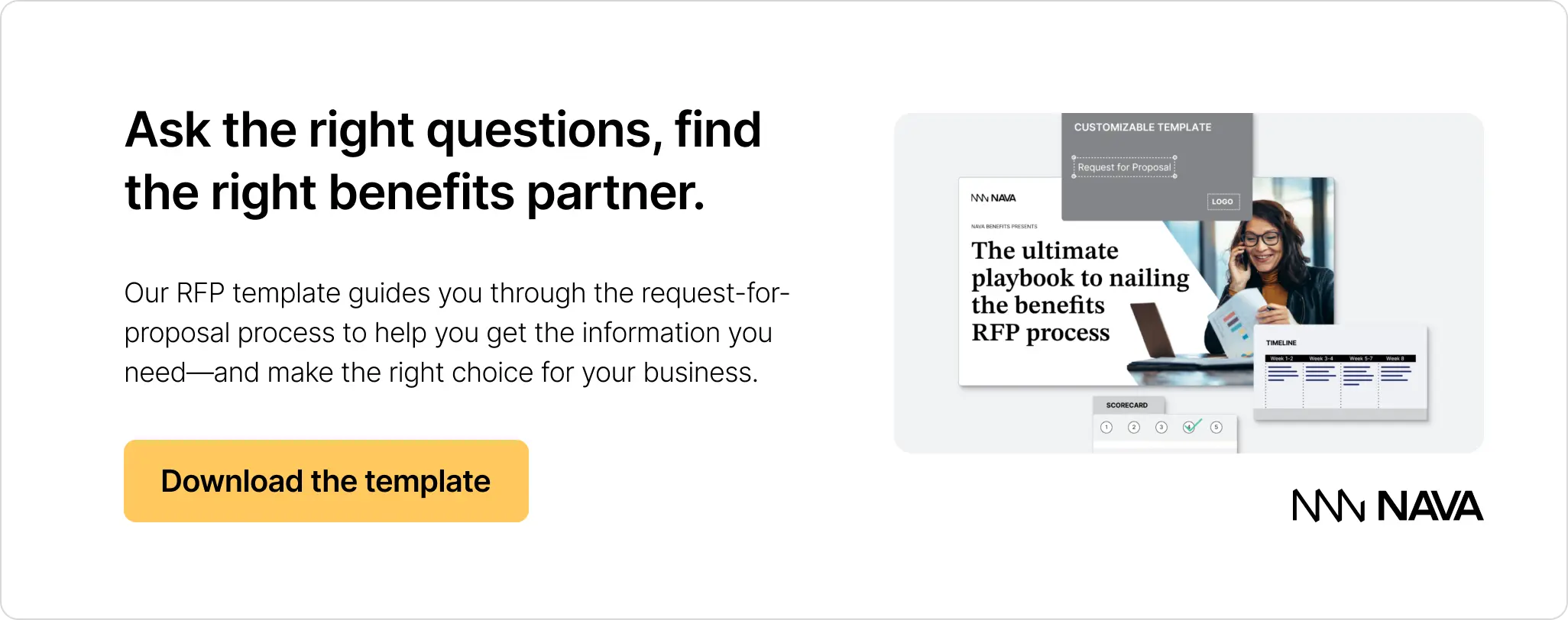
A benefits broker RFP (request for proposal) is a structured process employers use to evaluate and select a brokerage partner. It outlines your company’s needs, asks brokers for detailed information about their services, and allows you to compare vendors on a level playing field.
A strong RFP helps you understand how each broker approaches cost control, evaluate service depth and team expertise, compare technology and tools, ensure transparency around fees and incentives, and choose a partner aligned to your goals.
When should you issue a benefits broker RFP?
You should consider running an RFP when:
- Your renewal was higher than expected or lacked clear justification.
- Your business has changed (growth, new locations, new workforce needs).
- You’re not getting proactive, year-round support and only hear from your broker at renewal.
- Employee questions are overwhelming HR and your broker isn’t supporting day-to-day issues.
- Your current broker lacks modern tools like analytics, modeling, or employee-facing technology.
- You want a more strategic partner who can help you control costs and improve employee experience.
- You’re using a broker for the first time — for example, offering health insurance for the first time, moving off a PEO, or formalizing benefits as you scale.
Ideal timing: Issue your RFP 4–6 months before renewal so your team has space to evaluate, select a partner, and transition smoothly.
How to structure your broker evaluation
Before sending your RFP, identify the categories you’ll use to score broker responses. Start by clarifying your organization’s top priorities, whether that’s lowering renewal costs, improving employee support, reducing HR workload, strengthening compliance, or modernizing your tech stack. Those priorities should shape the categories you emphasize in your evaluation.
Common broker evaluation categories include:
- Experience & industry fit
- Services & support model
- Technology & analytics
- Employee communication & engagement
- Compliance expertise
- Fees & transparency
- Performance metrics & reporting
Use your top priorities to determine which categories matter most, then organize your RFP questions and scoring matrix around them. This makes it easier to compare finalists objectively and select the partner that best supports your goals.
15+ essential benefits broker RFP questions (with what good looks like)
Experience & industry fit
1. Describe your experience working with companies similar to ours. Look for industry understanding, similar employer size, and relevant case studies.
2. Who will be on our account team, and what are their roles? Look for dedicated consultants, clear responsibilities, and low turnover.
3. Provide two client references that reflect our size and complexity. Look for measurable outcomes and strong partnerships.
Services & support model
4. What services do you provide year-round, beyond open enrollment? Look for proactive support, vendor management, audits, and employee issue resolution.
5. How do you support HR during open enrollment? Look for communication planning, employee education, and onsite/virtual support.
6. What is your process for resolving employee issues with carriers? Look for fast turnaround, clear escalation paths, and high employee satisfaction.
Technology & analytics
7. What technology or platform do you provide to HR teams? Look for renewal modeling, benchmarking, data analysis, and centralized documents.
8. What employee-facing tools do you provide? Look for digital ID cards, mobile access, plan comparison tools, and AI-powered support.
9. How do you use data to inform plan design and cost control? Look for benchmarks, predictive analytics, and data-backed recommendations.
%20(1).webp)
Employee communication & engagement
10. What communication materials do you provide employees? Look for tailored, multi-lingual, multi-channel materials.
11. How do you help employees choose the right plan? Look for guided decision support, clear plan comparisons, and personalized recommendations.
Compliance expertise
12. How do you support ACA, ERISA, COBRA, and other compliance needs? Look for proactive monitoring, compliance calendars, and documented processes.
13. How do you track required notices and documentation? Look for automated tools, alerts, and centralized tracking.
Fees, commissions & transparency
14. How are you compensated? Look for transparent fee and commission breakdowns.
15. What additional fees should we be aware of? Look for full cost clarity and predictable pricing.
Reporting, performance & results
16. What metrics do you report on and how often? Look for renewal outcomes, service-level commitments, and satisfaction scores.
17. Share examples of recent cost containment success. Look for real results, creative strategies, and measurable impact.
How to compare and score broker RFP responses
Create a simple scoring matrix aligned with your priorities. Start by assigning a weight to each evaluation category based on what matters most to your organization. Then score each broker (typically on a 1–5 scale) in every category. Multiply the score by the weight to get a total. For example:
.webp)
This helps you separate strong brokers from “acceptable-but-average” options, especially when proposals look similar on paper.
What happens after the RFP?
Once you’ve scored and compared broker submissions, your next steps are to:
- Shortlist 2–3 finalists based on your scoring matrix and priorities.
- Hold live presentations or demos to evaluate service approach, team chemistry, and technology.
- Conduct reference checks with employers similar to your size and industry.
- Request a sample renewal or cost-control strategy to see how each broker would approach your plan.
- Make the final decision using both quantitative scoring and qualitative fit.
- Plan onboarding and transition to ensure vendors, systems, and employees are supported.
If you’re transitioning brokers, allow 6–8 weeks before open enrollment to ensure a smooth handoff.
Key Takeaways
- The right broker helps HR reclaim hours, control costs, and improve employee experience.
- A strong RFP focuses on seven categories: experience, support, technology, engagement, compliance, transparency, and results.
- Look for brokers that provide proactive strategy, year-round service, and modern tools.
- Use a scoring matrix to compare responses objectively.
- Run RFPs every 2–3 years or when your business changes significantly.


.webp)
